When Brent Willis talks about barium and iodine, he doesn’t sound like a CEO pitching a mining project. He sounds like a strategist describing a rescue mission—one designed to fix a broken global supply chain that the world’s hospitals rely on every single day.
For years, Willis and his team at Voyageur Pharmaceuticals have been chasing a deceptively simple idea: What if the critical chemicals used in X-rays, CT scans didn’t have to cross an ocean before they reached a patient? Not by relying on expensive, synthetic imports. Not by staying vulnerable to geopolitical shifts. But by owning the entire process—from the rock in the ground to the bottle on the shelf.
This year, that vision is moving from the laboratory to the front lines. With a landmark collaboration with Bayer and a patent-pending extraction technology, Voyageur is preparing to challenge the multi-billion-dollar titans of the contrast media industry.
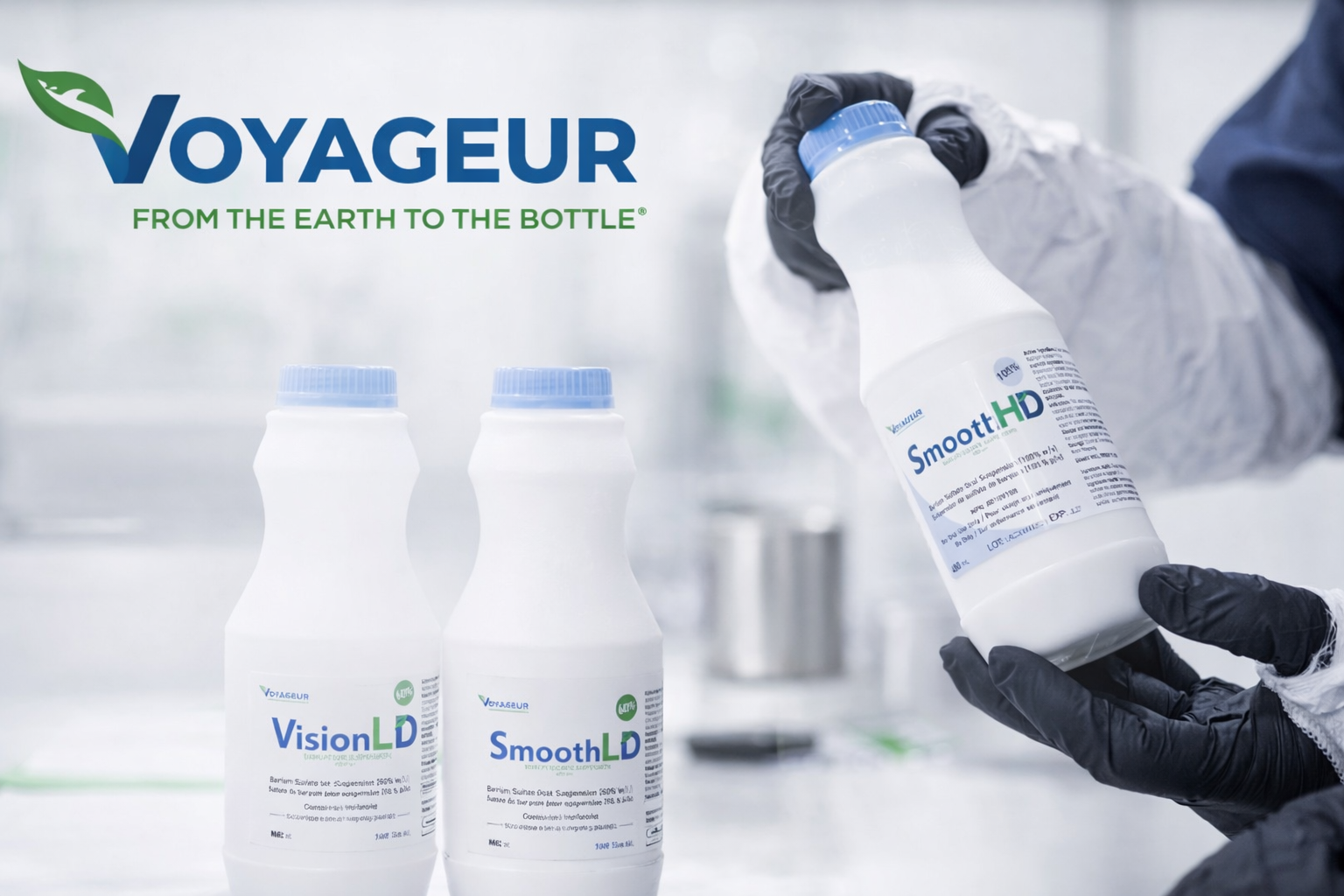
And Willis believes his team is about to prove that “Earth to Bottle” is more than a motto—it’s the future of pharmaceutical sovereignty.
A Market Built on Brittle Foundations
The world of diagnostic imaging is in the midst of a silent crisis. The global contrast media market is projected to nearly double to $13.8 billion by 2033, yet the supply chain for the two most critical ingredients—barium and iodine—is dangerously concentrated.
Most pharmaceutical-grade barium is synthetic and imported, often at costs exceeding $10,000 per tonne. Meanwhile, North America remains heavily dependent on offshore iodine, leaving healthcare systems vulnerable to shortages that can delay life-saving diagnoses for months.
The “bottleneck” isn’t just a matter of logistics; it’s a matter of security. For Voyageur, the solution wasn’t to find a better middleman—it was to eliminate the middleman entirely.
The Breakthrough: “From the Earth to the Bottle”
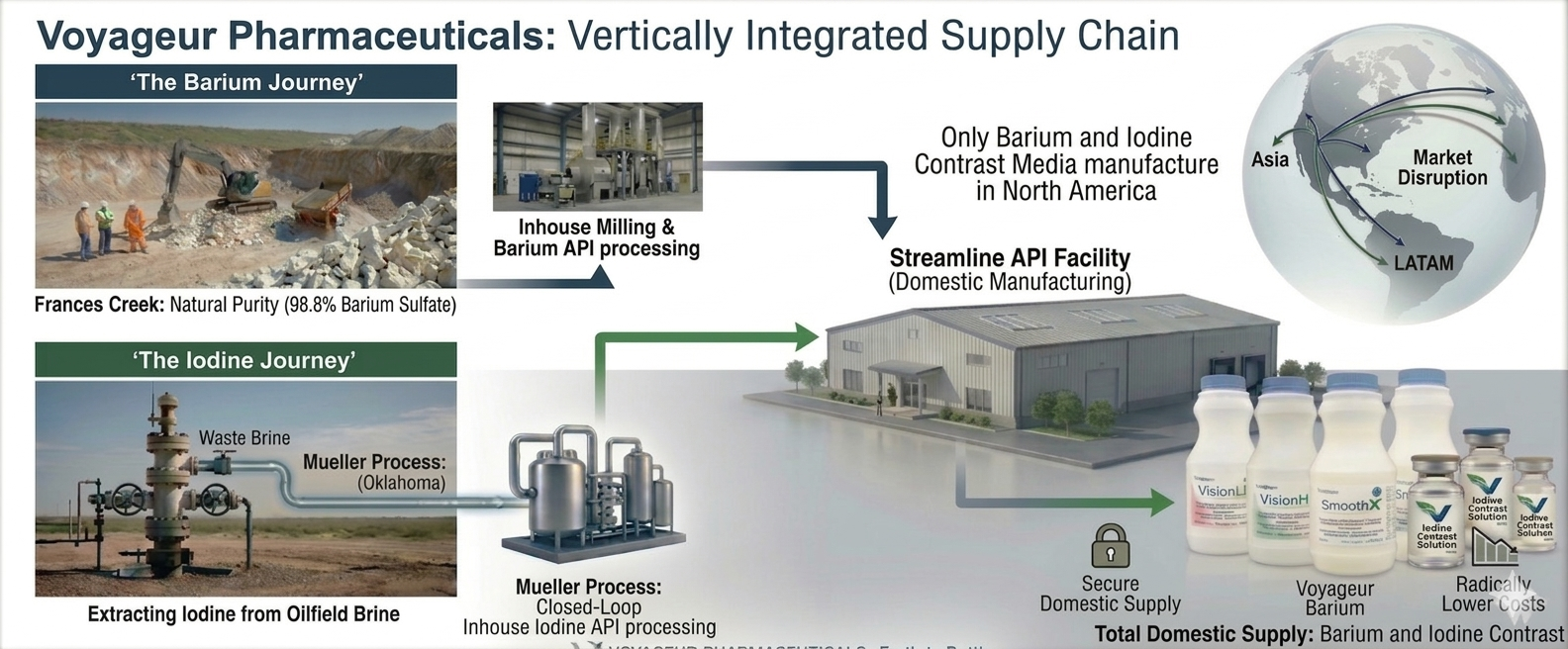
The journey began at Frances Creek in British Columbia. While others saw a standard barite deposit, Willis saw a geological unicorn: a natural source of barium sulfate so pure it exceeds pharmaceutical standards (98.8% purity) right out of the ground.
By bypassing the traditional, energy-intensive synthetic manufacturing process, Voyageur realized they could slash raw material costs from $10,000 to roughly $650 per tonne.
But barium was only half the battle. To truly disrupt the market, they needed iodine.
The breakthrough came via the Mueller Process, a proprietary iodine extraction technology Voyageur acquired in early 2026. Developed by Dr. Brian Mueller, this “closed-loop” system allows the company to extract iodine from oilfield brine water—waste water that is already being pumped to the surface.
“We aren’t just improving the supply chain,” Willis says. “We are reinventing how these drugs are born. We are going from the wellhead and the quarry directly to the Barium and Iodine radiology drug products.”
A David vs. Goliath Alliance
Voyageur signaled a major shift in the medical imaging landscape this February, landing a strategic funding partnership with Bayer to transform oilfield waste into a secure, North American source of pharmaceutical iodine.
The deal is a validation of Voyageur’s unconventional path. Bayer is providing milestone-based funding support of up to USD$2.35 million in staged funding to advance an iodine production project in Oklahoma. For a small Canadian firm, it is a “non-dilutive” injection of credibility and non-dilutive funding that moves the needle from speculative to inevitable.
By integrating the iodine extraction Mueller Process with Voyageur’s “Streamline” iodine drug platform, Voyageur is on track to become the first company in the North America to produce iodine contrast drugs domestically.
Why It Matters Now
The healthcare sector has long viewed contrast agents as a commodity—until they run out. Recent global shortages have proven that “just-in-time” delivery doesn’t work when the supply is thousands of miles away.
Voyageur’s model offers a “Triple Win”:
- Cost: Significant margin potential by owning the raw minerals (barium, iodine).
- Sustainability: Voyageur turns industrial liabilities into critical assets, converting oilfield brine waste into a sustainable, domestic source of high-value iodine minerals.
- Security: A secure, North American-based supply for critical minerals that the U.S. Geological Survey has flagged as “critical.”
The Human Drive Behind the Science
What makes the Voyageur story compelling isn’t just the “vertical integration math.” It’s the audacity of a Calgary-based team taking on a global oligopoly.
Willis and his COO, Brad Willis, have spent decades developing mineral properties. They didn’t set out to be “Big Pharma” disruptors; they set out to solve a scarcity problem. The current geopolitical climate simply arrived at the perfect moment—just as their technology matured, and just as the world realized it couldn’t afford to wait on a shipping container for a cancer screening.
“It’s not just about selling a bottle of contrast,” Willis says. “It’s about showing that we can build a resilient, high-margin, and environmentally responsible pharmaceutical industry right here at home.”
The Turning Point
As Voyageur advances its feasibility studies and FDA submissions for approval in late 2026, the company finds itself at an inflection point. They are no longer just a “mining story” or a “biotech play.” They are an infrastructure company for the human body.
Whether Voyageur can fully unseat the incumbents remains to be seen. But one thing is clear: the “Earth to Bottle” narrative has officially changed the conversation about where our medicine comes from—and who controls the source.
********************************************************************************
Sidebar: Voyageur Pharmaceuticals Quick Facts
- Corporate Goal: To disrupt the global contrast media market by creating a fully vertically integrated, “Earth to Bottle” supply chain for barium and iodine diagnostic drugs.
- The Problem: The $10B+ global market is vulnerable, reliant on expensive synthetic barium imports and offshore iodine (minerals scarcity).
- The Key Projects:
- Frances Creek, BC: A barite deposit of unprecedented natural purity (98.8%), suitable for pharmaceutical use without complex, costly synthetic processing.
- Oklahoma Iodine: Developing iodine production from oilfield brine water using the proprietary, “closed-loop” Mueller Process.
- Key Advantage (Vertical Integration): Owning the raw minerals drastically reduces production costs. Barium sulfate raw material cost is expected to drop from roughly $10,000/tonne (market price) to $650/tonne.
- Sustainability: Voyageur transforms industrial brine waste into a secure, domestic supply of high-value iodine contrast media, recapturing essential minerals while cleaning oilfield water streams.
- Strategic Alliance: Milestone-based funding agreement with Bayer to advance iodine production projects.
- Upcoming Milestones: Completion of Feasibility Studies (2026) and FDA drug submissions approval (late 2026).
- Ticker: TSX-V: VM / OTCQB: VYYRF
For details, please contact Ethan Mohan 403-803-0427 – ethan@vpharma.ca