
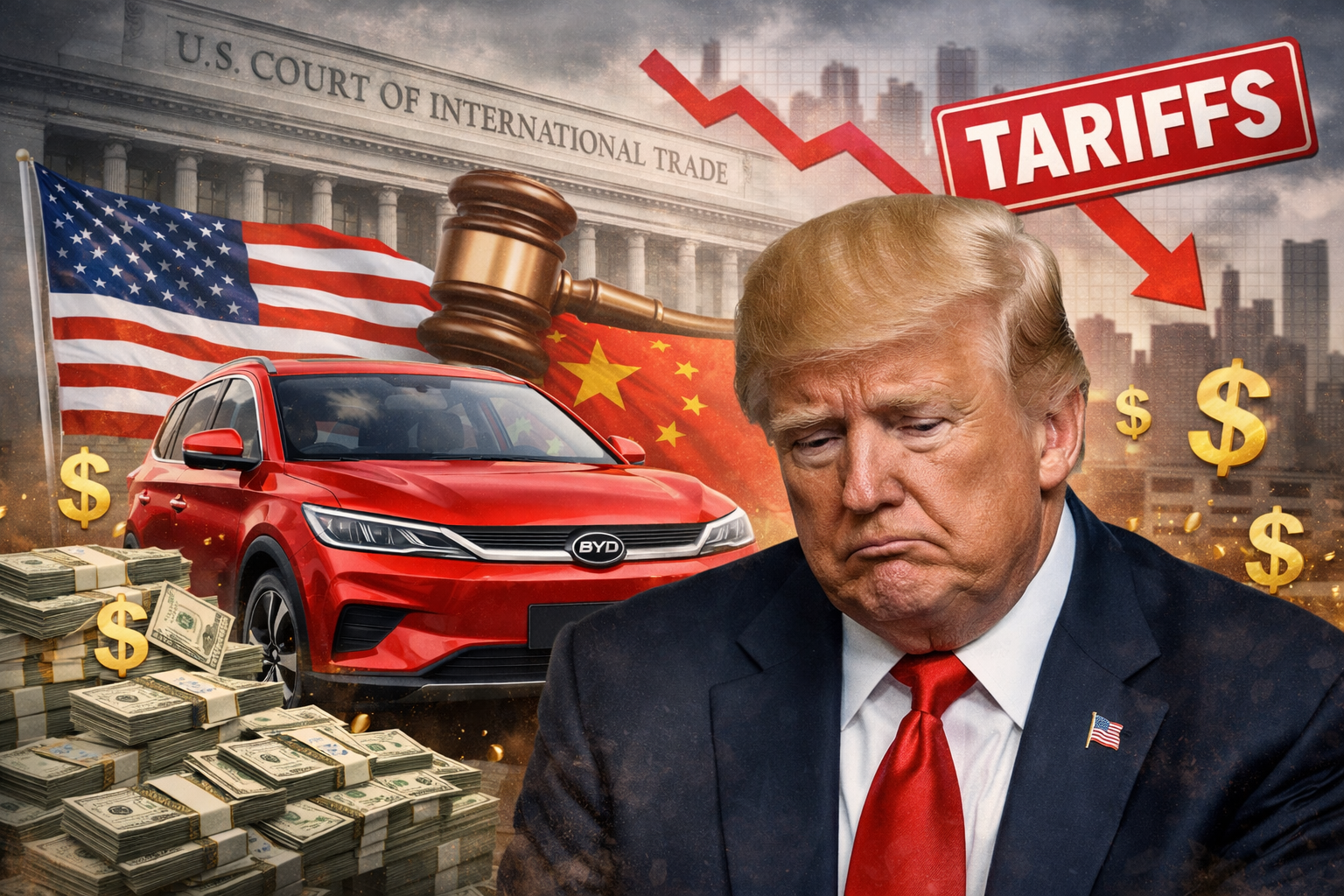
Chinese electric vehicle giant BYD has launched a legal challenge against the U.S. government over sweeping import tariffs imposed under President Donald Trump, marking the first known lawsuit by a Chinese automaker targeting Washington’s aggressive trade measures.
Court filings show BYD is seeking to overturn the tariffs and recover payments it has already made since they took effect last spring. The company argues that the White House exceeded its authority by invoking emergency economic powers to justify the levies, a strategy that has become a centerpiece of Trump’s renewed trade crackdown.
The case was filed in late January at the U.S. Court of International Trade, where four BYD subsidiaries operating in the United States contend that the law used by the administration — the International Emergency Economic Powers Act — was never intended to allow the president to impose what amount to import taxes. According to the complaint, the statute contains no language authorizing tariffs or similar border charges.
BYD’s lawsuit joins a growing wave of legal challenges from companies across multiple industries that say the administration has stretched emergency powers beyond their legal limits. Many of those firms argue the tariffs are disrupting supply chains, inflating costs, and undermining long-term investment planning.
At the center of the broader fight is a separate case now headed toward a pivotal Supreme Court ruling. The high court is expected to weigh whether the president can use emergency authority to unilaterally reshape U.S. trade policy. U.S. Trade Representative Jamieson Greer has publicly acknowledged the enormous economic implications of the decision, noting that the justices appear to be proceeding cautiously given how many industries and international relationships are at stake.
For BYD, the financial consequences are significant even though it does not sell consumer passenger vehicles in the American market. The company has steadily expanded its U.S. footprint through commercial transportation and clean energy operations. Its products in the country include electric buses, commercial trucks, lithium battery systems, large-scale energy storage units, and solar technology.
One of BYD’s most visible American operations is its truck manufacturing facility in Lancaster, California, which employs roughly 750 workers. The company has positioned itself as a contributor to domestic manufacturing and the clean energy transition — a point its legal team is likely to emphasize as the case moves forward.
The Trump administration, however, has repeatedly framed Chinese automotive and technology companies as strategic threats. The president has argued that low-cost Chinese vehicles and components could overwhelm U.S. manufacturers and weaken domestic industries. At the same time, Trump has occasionally suggested he would welcome Chinese firms that choose to build vehicles directly on U.S. soil, seeing local production as a way to create American jobs while maintaining strict controls on imports.
Trade analysts say BYD’s lawsuit highlights the increasingly complex relationship between national security policy, economic protectionism, and global manufacturing. While tariffs were once primarily tools of trade negotiation, the administration’s reliance on emergency powers has pushed them into new legal territory — one that courts are now being asked to define.
“If the courts limit how emergency authority can be used, it could dramatically reshape the way future presidents deploy tariffs,” said one international trade law expert. “It wouldn’t just affect China — it would affect every industry that relies on cross-border supply chains.”
Investors and manufacturers are watching closely, particularly as companies weigh whether to shift production to the United States, absorb higher costs, or scale back operations altogether.
BYD’s case, formally listed as No. 26-00847, could take months or longer to resolve, but its outcome may influence how other foreign and domestic firms pursue similar claims. In the meantime, the legal battle adds another layer of uncertainty to an already volatile global trade environment.
As tensions between Washington and Beijing remain high, the lawsuit underscores how economic policy is increasingly being decided not just in negotiations and executive orders, but in courtrooms — where the limits of presidential power are now under direct scrutiny.