
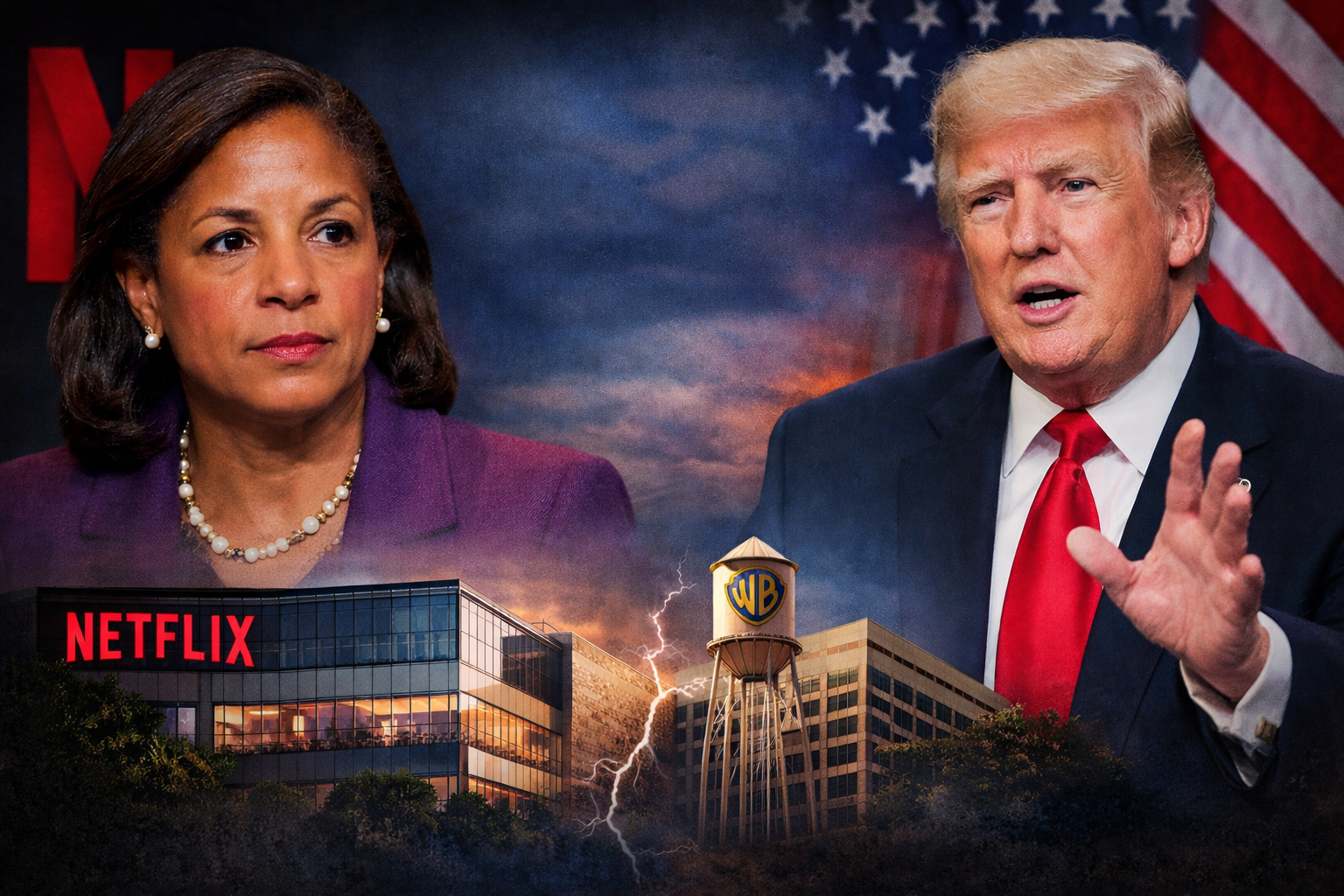
A proposed blockbuster combination between Netflix and Warner Bros. Discovery has taken on an unexpected political dimension after former President Donald Trump publicly criticized Netflix board member Susan Rice, injecting fresh uncertainty into an already complex regulatory process.
The streaming giant and Warner Bros. Discovery announced in December a transaction that would combine Netflix with Warner’s studio and streaming assets, valuing that portion of Warner’s business at approximately $82.7 billion. As part of the plan, Warner would spin off its Discovery Global cable networks into a separate company before completing the merger. The deal is subject to shareholder approval and regulatory review in the United States and abroad, with a shareholder vote scheduled for March 20.
Trump, posting over the weekend on his social media platform, called for Rice to be removed from Netflix’s board, describing her as a partisan figure and questioning her qualifications. Rice, a former U.S. national security adviser and longtime Democratic foreign policy official, has served on Netflix’s board since 2018. She stepped down temporarily while serving in the Biden administration and was reappointed to the board in 2023.
Rice recently appeared on the podcast “Stay Tuned with Preet,” where she discussed corporate responses to political pressure in Washington. During the interview, she argued that companies should be mindful of the long-term consequences of aligning too closely with any one administration, suggesting that political power in the United States inevitably shifts over time. Her comments circulated widely on social media amid the intensifying merger battle.
Netflix has not indicated any plans to alter its board composition. Under standard corporate governance practices, directors are elected by shareholders and can be removed only through formal board or shareholder action. The company has emphasized that the Warner transaction is a commercial matter subject to established legal and regulatory processes.
Co-CEO Ted Sarandos, speaking in a recent BBC interview, said the proposed combination is being reviewed by the U.S. Department of Justice and competition authorities in Europe and other jurisdictions. He characterized the merger as a business decision rather than a political one and reiterated that the approval process would follow normal regulatory channels.
The timing of Trump’s criticism is notable given the competitive landscape surrounding the Warner assets. Paramount Skydance, led by CEO David Ellison, has emerged as a competing bidder for the broader company in a deal reportedly valued at roughly $108.4 billion. Ellison is the son of Oracle co-founder Larry Ellison, who has hosted fundraisers for Trump and publicly supported him in the past. Warner has given Paramount a limited window to submit what it calls a “best and final” offer, which Netflix would have the right to match under the existing agreement.
The heightened rhetoric comes as regulators face increasing scrutiny over consolidation in the media and technology sectors. Streaming platforms now account for a substantial share of television viewing, and antitrust authorities have signaled a willingness in recent years to more aggressively examine mergers that could reduce competition or increase market concentration. Any perception that political considerations are influencing regulatory oversight could further complicate the review process.
Investors are watching closely as the bidding contest unfolds. Analysts say the outcome could reshape the competitive balance among major streaming and entertainment companies, potentially altering content pipelines, distribution strategies, and pricing power across the industry.
For now, Netflix is proceeding with its planned shareholder vote and regulatory filings, while rival suitors weigh their next moves. Whether Trump’s intervention has any practical effect on the transaction remains unclear. What is certain is that a deal initially framed as a strategic media consolidation has become entangled in the broader political currents shaping corporate America in an election year.